België / Belgique
 Français
 English
 The
Netherlands
The
Netherlands Deutschland
 International
Rainwear for your outdoor team: how to buy workwear that lasts
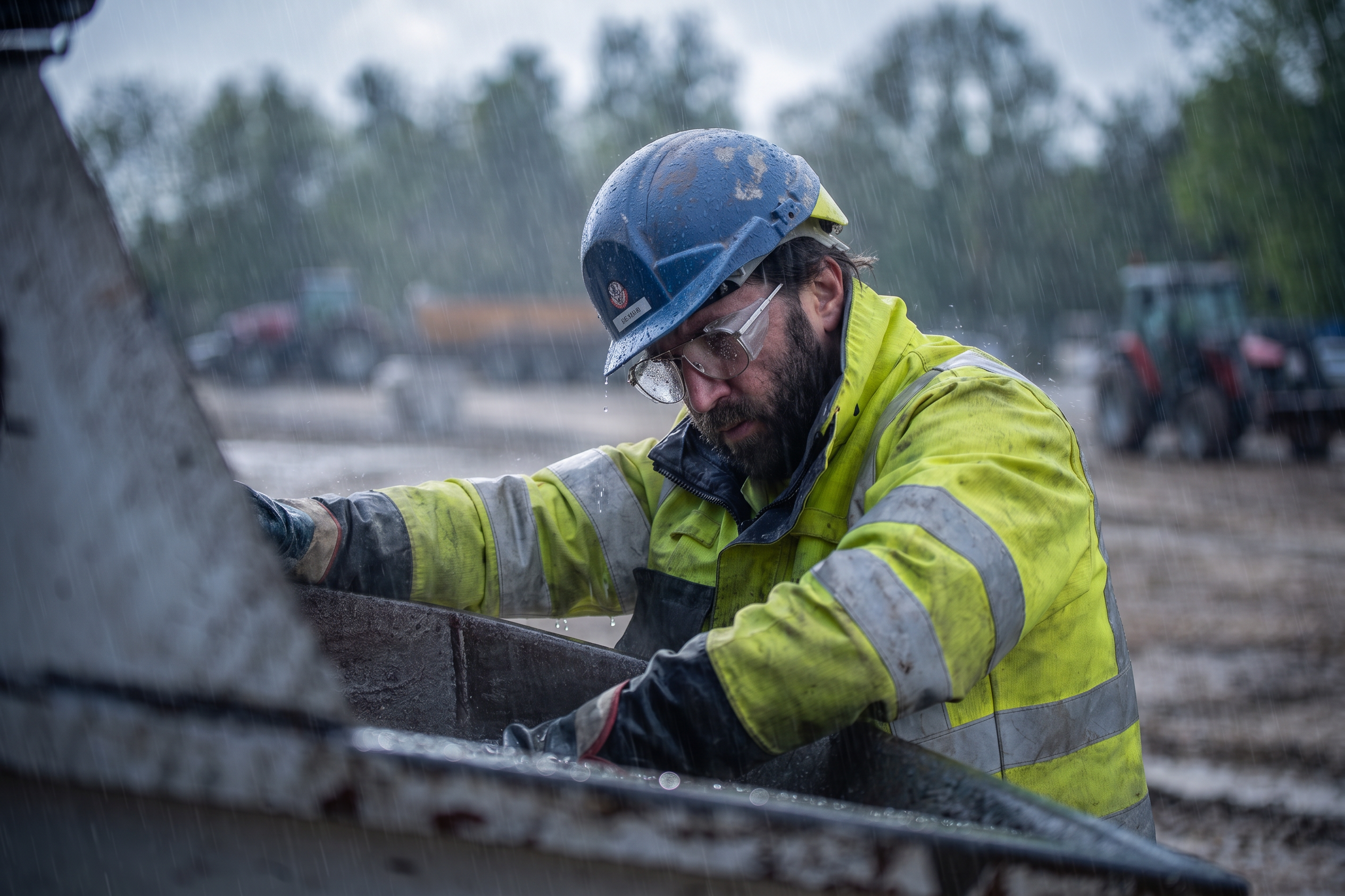
A purchasing manager orders rain jackets for the outdoor team in summer. The value for money looks good, the supplier promises waterproofing and the jackets seem robust. By December, after a few downpours, water starts seeping through the seams. By March, the jackets are worn out after a series of industrial wash cycles. And as summer approaches, the same manager has to order new rainwear again.
This scenario repeats itself every year in dozens of companies. The cost rarely lies in the purchase price itself, but in what happens afterwards.
Your outdoor team needs new rain jackets. You are comparing suppliers, looking at the unit price and do not want to be reordering in a year’s time. That is exactly the right starting point — because buying wind- and waterproof workwear begins with a few targeted questions.
Rain jackets or workwear jackets: which type suits your staff?
Not every jacket is suitable for professional outdoor use. Consumer rainwear is designed for occasional use and home laundering. Sending these jackets to an industrial laundry every week or fortnight will see them wear out within a single season.
Wind- and waterproof workwear for professional outdoor use is built differently: more durable fabrics, welded or taped seams, and a water-repellent finish capable of withstanding higher washing temperatures. The difference is not visible to the eye — it is in the technical data sheet.
If you opt for a complete rain outfit — jacket and trousers — the combination also matters. A waterproof jacket paired with non-water-repellent trousers only protects your staff halfway.
What does the EN 343 standard mean for waterproof rainwear in the workplace?
Rainwear for professional outdoor use falls under the European standard EN 343. This standard measures two properties: waterproofness (class 1 to 3) and breathability (class 1 to 3). A class 3 waterproofness rating means the fabric can withstand a water pressure of at least 13,000 mm — class 1 sets considerably lower requirements.
For purchasing managers, this goes beyond technical information. Under the Belgian Act on the Well-being of Workers, employers are required to provide adequate protection for employees who work outdoors in all weather conditions. A rain jacket certified to EN 343 is demonstrable proof that you as an employer are meeting that obligation. A jacket without certification or with a low classification does not formally provide that protection — and that can make a relevant difference during an inspection or in the event of a workplace accident.
What does rainwear for outdoor staff really cost on an annual basis?
Anyone who only looks at the unit price is missing the bigger picture. Rainwear that needs to be replaced after a single season brings the full purchase cost with it every year, along with the administrative burden of a new tender, delivery, and distribution.
High-quality rainwear, specifically developed for industrial laundering and compliant with EN 343 Class 3, costs more per item. However, a lifespan of multiple seasons instead of one significantly reduces the annual clothing cost. In addition, employees are far more likely to actually wear clothing that keeps them dry, which boosts productivity in wet conditions.
And there is a third factor that is rarely taken into account: sustainability. Every replaced jacket means new production, new transport, and new waste. Replacing items less frequently not only lowers the total cost, but also reduces the ecological footprint of your workwear policy. The purchase price is rarely the right metric. The cost per wash cycle, expected lifespan under industrial use, and employee willingness to wear it are what truly matter.
Which questions make the difference when buying waterproof rainwear?
When selecting rainwear for outdoor staff, several concrete questions are decisive for the quality of the purchase:
- What EN 343 classification does the jacket have, and against which standard has it been tested?
- Up to what washing temperature is the jacket suitable, and how many industrial wash cycles does the supplier guarantee?
- Are the seams simply stitched, or are they taped and heat-sealed?
- Can the water-repellent finish be restored or renewed after washing?
- Does the jacket also meet high-visibility requirements if staff work in the evening or in areas with heavy traffic?
A supplier who cannot provide clear answers to these questions is selling consumer rainwear — not corporate clothing for professional outdoor use.
Rainwear as part of a coherent workwear concept
Most outdoor team members do not work in constant rain. They alternate between driving, standing, walking and physical labour, at varying temperatures throughout autumn and winter. A rain jacket is just one layer — not the complete answer. The better the base and mid layers are chosen, the more effectively the outer layer performs — and the fewer complaints there are about cold, wet or uncomfortable working conditions.
This requires an approach in which rainwear is not treated as a standalone purchase, but as part of a coherent workwear concept per role. The requirements for logistics staff differ from those in construction or municipal outdoor services. Making that distinction at the point of purchase means ordering less often.
Van Moer supplies wind- and waterproof workwear for outdoor teams
Van Moer develops rainwear for outdoor staff in sectors such as logistics, industry, construction and municipal services. Our workwear meets EN 343 and is designed for industrial laundering — so that you do not need to reorder every year. We also think through the complete workwear clothing concept per role: from base layer to outer layer, tailored to the way your teams work in the field.
Would you like to know what this means in practice for your outdoor team? Contact our team →