België / Belgique
 Français
 English
 The
Netherlands
The
Netherlands Deutschland
 International
What are the requirements for medical clothing in healthcare?
Medical workwear is a cornerstone of hospitals and care institutions. For procurement managers, the decision goes far beyond colour or style, it is about predictable performance: hygiene, correct certification, wash durability, wearing comfort, and suitability for professional textile management.

Within healthcare, the terms used include care workwear, nursing uniforms, and medical uniforms. In specific environments such as the operating theatre, the focus shifts to Clean Air Suits (CAS), which must comply with stringent standards.
What does medical care workwear consist of?
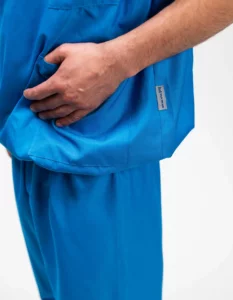
In practice, medical care workwear typically consists of a short-sleeved top and matching care trousers. This clothing is worn by nurses, doctors, theatre staff, and support services.
The design of a medical uniform is built around functionality. Short sleeves allow for correct hand and forearm disinfection. Fastenings are kept simple and free of unnecessary elements. Pockets are placed strategically, and the fit allows sufficient freedom of movement.
In operating environments, additional requirements apply. Here, Clean Air Suits (CAS) or specific theatre wear must comply with the EN 13795 standard, which focuses on barrier performance and contamination control.
What hygiene requirements must medical care workwear meet?
Hygiene is a fundamental prerequisite within healthcare. Medical clothing — including nursing uniforms and CAS — must therefore be suitable for intensive cleaning and daily use.
This means care workwear must be washable at a minimum of 60°C and compatible with industrial laundry facilities. The garments must retain their shape after repeated wash cycles and must not contain loose elements that could cause contamination.
The garments must retain their shape after repeated wash cycles and must not contain loose elements that could cause contamination. In specific environments such as the operating theatre, clothing must comply with EN 13795
which sets requirements for protection against the transfer of micro-organisms.
When clothing cannot withstand this level of use, it quickly loses its shape and function — leading to increased replacement rates and reduced control over stock management.
Why is wash durability critical for care institutions?
Zorgkledij wordt in veel instellingen voortdurend gewassen, opnieuw verdeeld en opnieuw gedragen. Daardoor is wasbestendigheid een belangrijke factor.
In many institutions, care workwear is continuously laundered, redistributed, and worn again. Wash durability is therefore a key consideration. Garments must retain their colour, shape, and finish even after a high number of wash cycles. This means minimal shrinkage, robust seams, and sufficient wear resistance in areas subject to intensive use. When clothing deteriorates or deforms too quickly, it must be replaced more frequently — increasing costs and reducing management efficiency.
Durability, in this context, means that garments remain fit for purpose over the long term without any loss of quality.
What role does material selection play in comfort and performance?
Healthcare professionals work in varying conditions — long shifts, physical demands, and temperature differences between departments.
Medical care workwear must therefore be breathable, manage moisture effectively, and feel sufficiently lightweight and flexible. At the same time, the fabric must be strong enough to withstand intensive laundering. Stretch in key movement zones and a quality inner finish increase wearing comfort during extended periods of use.
As working temperatures rise, breathability becomes even more important — without compromising durability.
How does fit affect the usability of care workwear?
Fit is a functional procurement criterion. A poorly fitting garment leads to complaints more quickly, reduces willingness to wear it, and accelerates wear and tear.
A practical fit ensures that staff can move freely without strain on seams or discomfort during work. It is therefore important to trial garments with a range of wearers within the organisation, so that the final choice reflects real working conditions.
What details determine the quality of medical clothing?
Beyond fabric and fit, it is the details that determine the reliability of care workwear in daily use.
Beyond fabric and fit, it is the details that determine the reliability of care workwear in daily use. Reinforced pockets, robust seams, quality waistbands, and a durable finish make a measurable difference to longevity. Minor defects, such as a tearing pocket or a failing fastening, result in garments being taken out of service and replaced sooner than necessary.
How should the cost of medical care workwear be assessed correctly?
The purchase price per item is only part of the picture. Within care institutions, the total cost over the garment’s lifetime is what matters most.
This involves assessing how long clothing remains fit for use, how many wash cycles it can withstand, and how frequently replacement is required. Lower-priced clothing may ultimately prove more expensive due to faster deterioration and more frequent replacement.
Conclusion: When is medical care workwear truly fit for purpose?
Medical care workwear is only truly fit for purpose when it continues to perform as required within the care environment over the long term. That means it complies with hygiene guidelines, is suitable for industrial laundering, retains its shape and colour, and provides adequate comfort throughout full shifts.
When these criteria are clearly defined in advance, procurement decisions become more consistent and care workwear remains reliably fit for service for longer. In a sector where dependability is essential, clothing must perform just as predictably.